

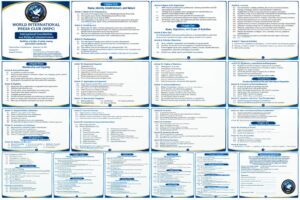
WORLD INTERNATIONAL PRESS CLUB (WIPC)
World International Press Club
International Constitution and Rules of Administration
Organization’s Motto: Building a bridge of unity among journalists worldwide.
Proposed Date of Establishment: September 24, 2023.
Headquarters: Bangladesh.
Scope of Activities: To work for the professional rights, safety, dignity, unity, mutual cooperation, and welfare of journalists in Bangladesh and all countries and regions of the world.
—
Chapter One
Name, Identity, Establishment, and Nature
Article 1. Name of the Organization
1.1 The name of the organization shall be World International Press Club.
1.2 The English name shall be World International Press Club.
1.3 The abbreviated name shall be WIPC.
1.4 The organization shall operate as an international organization dedicated to journalistic unity, rights, safety, professional development, and welfare.
Article 2. Establishment
2.1 September 24, 2023, is hereby designated as the date of establishment of the organization.
2.2 Recognition of the founding members, the founding committee, and the historical details of the establishment shall be recorded in the organization’s preserved documents.
2.3 The date of establishment and details of the founding committee shall be finally preserved in accordance with verified documents.
Article 3. Headquarters
3.1 The international headquarters of the organization shall be located in Bangladesh.
3.2 The full address of the headquarters shall be determined in accordance with the decision of the Central Executive Committee and applicable registration documents.
3.3 If necessary, the address of the headquarters in Bangladesh may be changed with the approval of the Central Executive Committee.
3.4 National offices, regional offices, representative offices, and authorized branches may be established in different countries around the world.
3.5 No branch in any country may conduct activities in violation of the laws of that country.
Article 4. Nature of the Organization
4.1 WIPC shall be an international, professional, voluntary, and welfare-oriented organization of journalists.
4.2 The activities of the organization shall be peaceful, lawful, transparent, non-discriminatory, and respectful of journalistic freedom and ethics.
4.3 The organization shall not be operated for the personal profit of any individual, group, or institution.
4.4 The organization shall work to protect the professional interests of journalists and shall respect the members’ right to freedom of expression.
4.5 The organization’s international identity, name, logo, seal, letterhead, and other symbols shall be used in accordance with rules approved by the Central Executive Committee.
—
Chapter Two
Goals, Objectives, and Scope of Activities
Article 5. Main Goal
To unite journalists from around the world on a common international platform and work to ensure their professional rights, safety, dignity, freedom, and welfare.
Article 6. Principal Objectives
The objectives of the organization shall be to—
6.1 Establish unity, solidarity, mutual cooperation, and friendship among journalists from different countries of the world.
6.2 Adopt peaceful, democratic, and lawful programs to achieve the legitimate demands of journalists.
6.3 Conduct protests and preventive activities against the persecution, harassment, threats, attacks, unlawful detention, enforced disappearance, abduction, and killing of journalists.
6.4 Work to protect the lives, safety, professional dignity, and freedom of journalists.
6.5 Undertake activities in support of fair remuneration, working conditions, job security, and social protection for journalists.
6.6 Arrange training, workshops, seminars, international conferences, and exchanges of experience for journalists.
6.7 Initiate the establishment of funds to provide legal assistance, emergency support, and welfare services for journalists.
6.8 Undertake activities to assist sick, injured, persecuted, unemployed, endangered, and financially disadvantaged journalists.
6.9 Take necessary initiatives to support the families of deceased journalists, persecuted journalists, and their dependents.
6.10 Work to improve professional standards, integrity, impartiality, fact-checking, public interest, and ethics in journalism.
6.11 Create awareness to prevent journalism by persons using false identities, fraudulent use of identity cards, and misuse of the name of journalism.
6.12 Expand mutual benefits, information exchange, professional communication, and international networks among journalists.
6.13 Work on the professional participation and safety of women journalists, young journalists, freelance journalists, and journalists working in high-risk environments.
6.14 Document violations of journalists’ rights and present relevant information to appropriate authorities, human rights institutions, and concerned organizations.
6.15 Undertake research, publications, newspapers, periodicals, online portals, and other media-based initiatives for the professional development of journalists.
6.16 Establish lawful cooperation with international journalists’ organizations, media institutions, human rights organizations, educational institutions, and relevant agencies.
6.17 Prevent discrimination among journalists on the basis of religion, race, nationality, language, gender, political opinion, or any other identity.
6.18 Raise awareness of freedom of journalism and the public’s right to access information.
Article 7. Types of Activities
To achieve its objectives, the organization shall—
a. Organize international and national conferences.
b. Publish statements, reports, and recommendations on journalists’ rights and safety.
c. Undertake lawful human chains, discussion meetings, seminars, press conferences, and awareness programs.
d. Conduct training and skills-development programs for journalists.
e. Establish welfare funds, emergency assistance programs, and systems of mutual cooperation.
f. Develop technology-based systems for communication and information exchange among members.
g. Communicate with relevant authorities regarding journalists’ rights and safety when necessary.
h. Conduct other lawful activities consistent with the objectives of the organization.
—
Chapter Three
Membership and Eligibility
Article 8. General Principles of Membership
8.1 Any qualified journalist from any country in the world may apply for membership of WIPC.
8.2 No discrimination shall be made in granting membership on the basis of nationality, religion, race, language, gender, political opinion, or social identity.
8.3 To obtain membership, an applicant must agree to comply with this Constitution, the objectives of the organization, its ethical standards, and its Code of Conduct.
8.4 Verification of a journalistic identity card and valid identification from the relevant media organization shall be a mandatory condition of membership.
Article 9. Eligibility for Membership
To become an ordinary member, an applicant must—
9.1 Be associated as a journalist with a lawfully operated, registered, or recognized newspaper, news agency, television station, radio station, online news outlet, or other recognized media organization.
9.2 Possess a valid journalist identity card issued by the relevant media organization or newspaper.
9.3 Have an identity card containing the applicant’s name, photograph, designation, name of the media organization, and necessary identifying information.
9.4 Provide certification from the relevant media authority or proof of appointment, if necessary, for verification of the authenticity of the identity card.
9.5 Complete the membership application form prescribed by the organization.
9.6 Provide accurate personal and professional information.
9.7 Agree to comply with the Constitution, Code of Conduct, and lawful organizational decisions of the organization.
9.8 Meet the applicable age-of-majority requirement under the laws of the relevant country. In the case of a minor applicant, the laws of the relevant country and the organization’s special policies shall apply.
Article 10. Documents Required for Membership
The following documents may be requested with an application—
a. Completed membership application form.
b. Recent passport-size photograph.
c. Copy of the journalist identity card issued by the media organization or newspaper.
d. Appointment letter, certification, or proof of professional association with the relevant media organization, if necessary.
e. Applicant’s contact address, email address, and telephone number.
f. A brief description of professional experience, where required.
g. Proof of payment of the membership fee prescribed by the organization, if applicable.
Article 11. Application and Approval of Membership
11.1 An applicant may apply through the central office, an authorized national branch, or the online system designated by the organization.
11.2 The relevant Membership Verification Committee shall verify the applicant’s documents and professional identity.
11.3 After verification, the Central Executive Committee or its authorized authority may approve or reject the application.
11.4 If an application is rejected, the applicant shall, as far as possible, be informed of the reasons in writing.
11.5 The applicant may appeal the decision to the designated Appeals Committee.
11.6 Upon approval of membership, the member shall be assigned a unique membership number.
11.7 A central membership register containing the names, membership numbers, countries, affiliated media organizations, and membership status of members shall be maintained.
Article 12. Categories of Membership
The organization may have the following categories of membership—
12.1 Ordinary Member: A journalist approved after fulfilling the prescribed qualifications.
12.2 Life Member: A member approved on the basis of special contribution or payment of the prescribed one-time fee.
12.3 Honorary Member: A person who has made a significant contribution to journalism, human rights, media freedom, or journalists’ welfare may be granted honorary membership through special approval. The requirement of a journalist identity card may not apply to an honorary member in the same manner as it applies to an ordinary member; however, an honorary member shall not automatically have the voting rights of an ordinary member.
12.4 Founding Member: A person recognized as a founder in the organization’s founding documents.
12.5 Associate Member: An individual or institution supporting the welfare of journalists and the objectives of the organization may be granted associate membership under prescribed policies. An associate member shall not have the voting rights of an ordinary member unless separately qualified under this Constitution.
Article 13. Rights of Members
Eligible and active ordinary members shall—
13.1 Participate in the activities of the organization.
13.2 Attend the General Assembly in accordance with the Constitution.
13.3 Vote in accordance with the prescribed voting rights.
13.4 Stand as candidates in elections if they meet the qualifications for the relevant position.
13.5 Apply for approved welfare benefits of the organization.
13.6 Submit professional problems, safety risks, and welfare-related requests to the organization.
13.7 Obtain information about the organization’s approved reports, accounts, and activities in accordance with the prescribed rules.
13.8 Submit organizational proposals, complaints, and appeals in accordance with the Constitution.
Article 14. Duties of Members
Every member shall—
14.1 Comply with the Constitution, policies, and Code of Conduct of the organization.
14.2 Keep their journalistic identity and professional information accurate and up to date.
14.3 Not use the organization’s name, logo, seal, identity card, or designation to obtain unlawful personal benefits.
14.4 Maintain mutual respect, discipline, and cooperation in the interests of the organization.
14.5 Respect journalistic ethics, the accuracy of information, and the public interest.
14.6 Not misuse the organization’s funds, assets, or documents.
14.7 Not make financial commitments, contracts, or official statements in the name of the organization without authorization.
14.8 Maintain the conditions of membership and, when required, renew their identity card or provide updated proof of professional association.
Article 15. Suspension, Cancellation, and Resignation of Membership
15.1 If a member’s identity card is proven to be forged or invalid, membership may be suspended or cancelled following an investigation.
15.2 Action may be taken after investigating allegations of embezzlement of organizational funds, serious misconduct, fraud, abuse of power, or serious violation of the Constitution.
15.3 A member may resign in writing.
15.4 Before membership is cancelled, the member concerned must be informed of the allegations and given a reasonable opportunity to present a defense.
15.5 An appeal may be filed against disciplinary decisions within the prescribed period.
15.6 The decision to cancel or suspend membership shall take effect through a written order of the appropriate authority.
—
Chapter Four
Country-Based Branches and International Expansion
Article 16. Formation of National Branches
16.1 A national branch of WIPC may be formed in any country of the world.
16.2 At least five qualified and verified journalist members must be present to form a national branch in any country.
16.3 Each of the five members must fulfill the membership qualifications set out in this Constitution.
16.4 Members of the relevant country shall apply to form a national branch.
16.5 The application shall include the proposed committee list, members’ identity cards, contact addresses, proposed action plan, and other required documents.
16.6 After approval by the Central Executive Committee, the relevant branch shall be formally recognized as a national branch of WIPC.
16.7 After the formation of a branch, a National Executive Committee may be formed from among the approved members.
16.8 The name of the national branch shall be “World International Press Club—[Name of Country] Chapter” or an equivalent name approved centrally.
Article 17. Arrangements for Countries with Fewer Than Five Members
17.1 A full national branch may not be formed in a country until five qualified members are available.
17.2 However, if there are one to four qualified members, the Central Executive Committee may appoint one of them as an interim Country Coordinator.
17.3 The Interim Coordinator shall take initiatives to recruit new qualified members.
17.4 Once five qualified members are available, an application may be submitted to form a national branch.
Article 18. Responsibilities of National Branches
A national branch shall—
18.1 Work for the unity, rights, and welfare of journalists in the relevant country.
18.2 Follow the central Constitution and approved policies.
18.3 Assist the central authority in verifying membership applications.
18.4 Send updated membership lists and activity reports to the central office.
18.5 Comply with the registrations, permissions, and administrative requirements applicable under the laws of the country.
18.6 Not create international agreements, loans, financial liabilities, or obligations in the name of the organization without central approval.
Article 19. Autonomy and Limitations of Branches
19.1 A national branch shall enjoy administrative autonomy in conducting local activities, subject to the Constitution and central policies.
19.2 A national branch shall comply with the laws of the relevant country, media-related regulations, and applicable registration requirements.
19.3 No national branch may enact rules that conflict with the central Constitution.
19.4 In the event of serious irregularities by a national branch, the Central Executive Committee may take corrective measures following an investigation.
19.5 The relevant branch must be given an opportunity to present a defense in cases of dissolution, suspension, or reorganization.
—
Chapter Five
Organizational Structure
Article 20. Organizational Bodies and Administrative Structure
The organizational structure of WIPC shall consist of—
a. International General Assembly.
b. International Executive Committee.
c. International Advisory Council.
d. International Secretariat.
e. Regional Coordination Council.
f. National branches and National Executive Committees.
g. Divisional, provincial, state, district, or local coordination units, as necessary.
h. Permanent and temporary subject-based committees.
Article 21. International General Assembly
21.1 The International General Assembly shall be the highest policy-making authority of the organization.
21.2 Voting members and approved representatives shall participate in the General Assembly in accordance with the Constitution.
21.3 The General Assembly shall ordinarily be held every two years.
21.4 In special circumstances, the General Assembly may be held online, virtually, or in a hybrid format.
21.5 The principal powers of the General Assembly shall be to—
Approve and amend the Constitution.
Elect the International Executive Committee.
Approve the organization’s policies and long-term plans.
Review the annual report and audited accounts.
Make important organizational decisions.
Ensure accountability of the Executive Committee when necessary.
Decide on the dissolution of the organization in accordance with the Constitution.
Article 22. International Executive Committee
22.1 The International Executive Committee shall conduct the day-to-day activities of the organization.
22.2 The proposed positions of the Committee shall be—
International Chairman
International President
Senior Vice President
International Vice President
International Secretary-General
Joint Secretary-General
Organizing Secretary
International Office Secretary
Finance Secretary
International Publicity and Publications Secretary
International Legal and Human Rights Secretary
Journalists’ Safety Secretary
International Welfare Secretary
Training and Research Secretary
Secretary for Women Journalists’ Affairs
Information and Technology Secretary
Executive Members
22.3 The number of Executive Committee members, country-based representation, and allocation of positions shall be approved by the General Assembly.
22.4 Efforts shall be made to ensure representation from different regions and countries of the world on the Committee.
22.5 If any position becomes vacant, an interim assignment may be made in accordance with the Constitution.
Article 23. International Chairman
23.1 The International Chairman shall serve as the organization’s highest institutional guardian.
23.2 The Chairman shall provide guidance on the organization’s long-term goals, unity, policies, and international relations.
23.3 The Chairman shall preside over meetings of the International General Assembly and the Executive Committee or, in the Chairman’s absence, the designated alternate shall preside.
23.4 The Chairman shall not unilaterally spend the organization’s funds, amend the Constitution, cancel membership, or dissolve the Executive Committee.
23.5 The Chairman’s authority shall remain subject to the Constitution, decisions of the General Assembly, and joint decisions of the Executive Committee.
Article 24. International President
24.1 The International President shall oversee the implementation of the organization’s policies and executive activities.
24.2 The President shall assist the Secretary-General in convening meetings of the Executive Committee and coordinating its activities.
24.3 In the absence of the Chairman or if the Chairman is unable to perform the duties of office, the President shall perform the duties of the Chairman in accordance with the Constitution.
24.4 The President shall not create financial or legal obligations for the organization without the approval of the Executive Committee.
Article 25. International Secretary-General
25.1 The International Secretary-General shall serve as the organization’s chief administrative coordinator.
25.2 The Secretary-General shall—
Manage the administrative activities of the central office.
Preserve notices, minutes, and decisions of meetings.
Coordinate membership registration and communication with branches.
Prepare the annual activity report.
Oversee implementation of Executive Committee decisions.
Preserve approved documents and organizational communications.
25.3 The Secretary-General shall not unilaterally make policy decisions beyond the organization’s approved decisions.
Article 26. Finance Secretary
26.1 The Finance Secretary shall maintain records of the organization’s income and expenditure.
26.2 The Finance Secretary shall maintain the approved budget, bank accounts, receipts, vouchers, and financial documents.
26.3 The Finance Secretary shall submit financial reports to the Executive Committee at the prescribed times.
26.4 The organization’s funds shall not be deposited into a personal account unless a lawful and specially approved written arrangement exists.
Article 27. Other Secretaries and Executive Members
27.1 Each Secretary shall perform the duties approved by the Executive Committee.
27.2 The Journalists’ Safety Secretary shall assist in documenting allegations of attacks, threats, and persecution against journalists.
27.3 The International Welfare Secretary shall coordinate welfare activities and assistance programs for members.
27.4 The Training and Research Secretary shall play a role in conducting training, research, publications, and skills-development programs.
27.5 Executive Members shall participate in meetings, present proposals, and assist in implementing adopted decisions.
—
Chapter Six
Elections, Terms of Office, and Vacancies
Article 28. Principles of Election
28.1 The International Executive Committee shall be formed through democratic, transparent, and impartial elections.
28.2 An independent Election Commission shall be formed to conduct the election.
28.3 The Election Commission shall verify candidates’ qualifications, prepare the voter list, conduct voting, count votes, and announce the results.
28.4 A secure electronic voting system may be used when necessary.
28.5 Detailed election procedures shall be prescribed in separate Election Rules.
Article 29. Term of the Committee
29.1 The term of the International Executive Committee shall be two years.
29.2 Until a new Committee is elected by the General Assembly, the outgoing Committee may conduct routine and emergency activities.
29.3 The outgoing Committee shall not create unreasonable obstacles to the assumption of office by the new Committee.
29.4 Eligibility for re-election and limitations on terms of office shall be prescribed in the Election Rules.
Article 30. Vacancies
A position may become vacant for the following reasons—
a. Written resignation.
b. Death.
c. Ineligibility to hold office under the laws of the relevant country.
d. Removal following proper investigation and decision for serious misconduct.
e. Long-term inability to perform duties, as determined through due process.
f. Any other reason prescribed by the Constitution.
Article 31. Resignation and Removal
31.1 An officer may resign in writing.
31.2 An investigation may be initiated against an officer on serious allegations.
31.3 The accused officer must be informed of the details of the allegations and given an opportunity to present a defense.
31.4 No person may be removed as a disciplinary measure without proper investigation and decision.
31.5 An appeal may be filed with the designated appellate authority against removal.
—
Chapter Seven
Meetings and Decision-Making
Article 32. Types of Meetings
The following meetings may be held within the organization—
32.1 International General Assembly.
32.2 Special International General Assembly.
32.3 Meeting of the International Executive Committee.
32.4 Meeting of the International Advisory Council.
32.5 General meeting of a national branch.
32.6 Meeting of a National Executive Committee.
32.7 Meeting of a subject-based committee.
Article 33. Convening Meetings
33.1 Notice of a General Assembly meeting shall, as far as possible, be given at least 30 days in advance.
33.2 Notice of an Executive Committee meeting shall ordinarily be given at least seven days in advance.
33.3 In an emergency, a meeting may be convened with reasonably shortened notice.
33.4 Notice may be given by email, an approved digital medium, or in writing.
Article 34. Quorum
34.1 The quorum for the International General Assembly shall be one-third of the voting members or approved representatives.
34.2 The quorum for the International Executive Committee shall be more than half of its total members.
34.3 If a quorum is not present, the meeting may be adjourned and reconvened.
34.4 The quorum requirements for a reconvened meeting shall be prescribed in the Election and Meeting Rules; however, the special quorum prescribed for amendment of the Constitution and dissolution shall remain mandatory.
Article 35. Decision-Making
35.1 Ordinary decisions shall be adopted by a simple majority of the voting members present.
35.2 The special majority prescribed in this Constitution shall apply to amendments to the Constitution, dissolution, and other matters of special importance.
35.3 In the event of a tie, the decision-making procedure determined by the Chair of the meeting shall be followed; ties relating to elections shall be resolved in accordance with the Election Rules.
35.4 Minutes of meetings shall be preserved in writing.
—
Chapter Eight
Finance, Funds, and Financial Transparency
Article 36. Sources of Funds
The organization’s sources of funds may include—
a. Membership fees.
b. Annual renewal fees, if prescribed.
c. Life membership fees.
d. Lawful donations and voluntary contributions.
e. Income from training, publications, conferences, and approved activities.
f. Other lawful sources.
Article 37. Membership Fees
37.1 Membership fees, renewal fees, and other prescribed fees shall be determined on the proposal of the International Executive Committee and with the approval of the General Assembly.
37.2 Reasonable differences in fees may be maintained in consideration of the socioeconomic conditions of different countries.
37.3 Proper receipts shall be issued for all fees received.
37.4 All provisions relating to fees shall be published in writing.
Article 38. Bank Accounts and Safekeeping of Funds
38.1 Lawful bank accounts shall be opened in the name of the organization.
38.2 At least two authorized signatories shall be designated to operate the bank accounts.
38.3 Approved financial policies shall be followed for withdrawals and expenditures.
38.4 The organization’s funds shall not be used as personal property.
Article 39. Budget and Audit
39.1 A budget shall be prepared for each financial year.
39.2 Annual income and expenditure accounts shall be prepared and submitted to the Executive Committee.
39.3 The organization’s accounts shall be audited by an independent and qualified auditor where legally required or prescribed by the organization’s policies.
39.4 The audit report shall be presented to the General Assembly.
39.5 Independent investigations may be arranged to investigate allegations of financial irregularities.
Article 40. Welfare Fund
40.1 A separate fund may be established for emergency assistance and welfare of journalists.
40.2 Written policies shall govern the use of the fund.
40.3 Records of applications, verification, approvals, and expenditures shall be maintained for all assistance provided.
40.4 The fund shall not be used for the personal benefit of any officer or member.
40.5 Decisions regarding assistance shall be transparent, fair, and non-discriminatory.
—
Chapter Nine
Journalists’ Safety, Rights, and Welfare
Article 41. Prevention of Persecution of Journalists
41.1 Upon receiving an allegation of an attack, threat, harassment, unlawful detention, or any other violation of a journalist’s rights, the organization may initiate documentation of the matter.
41.2 After verifying the allegation, the organization may issue statements, protests, lawful applications, or take supportive measures.
41.3 No allegation may be publicized as conclusively true without verification.
41.4 Information shall be disclosed with consideration for the affected journalist’s consent and safety.
Article 42. Emergency Assistance
42.1 Emergency assistance mechanisms may be established for journalists at risk.
42.2 The types, limits, eligibility requirements, and approval procedures for assistance shall be prescribed in separate policies.
42.3 Available resources, the urgency of the need, and safety considerations shall be taken into account when providing assistance.
Article 43. Legal Assistance
43.1 If journalists face legal problems because of performing their professional duties, the organization may initiate assistance within the limits of applicable law and available resources.
43.2 The laws and professional regulations of the relevant country shall be followed when providing legal assistance.
43.3 The organization shall not assist any member in unlawful activities.
Article 44. Training and Professional Development
44.1 Training may be provided on journalists’ skills, fact-checking, digital security, investigative journalism, media law, and ethics.
44.2 Training programs may be conducted at the international and national levels.
44.3 If training certificates are issued, their standards and approval procedures shall be prescribed in writing.
—
Chapter Ten
Code of Conduct and Discipline
Article 45. Professional Conduct
45.1 Members shall uphold truthfulness, fairness, professional integrity, and respect for the public interest.
45.2 The organization’s identity shall not be used to intimidate, extort, defraud, or obtain unlawful benefits.
45.3 Members shall maintain mutual respect and decorum within the organization.
45.4 Misuse of the organization’s funds, assets, identity cards, or logo shall constitute misconduct.
45.5 Unauthorized appointments, granting of positions, or sale of memberships in the name of the organization shall be prohibited.
Article 46. Disciplinary Measures
Depending on the seriousness of the allegation and the outcome of the investigation, the following measures may be taken—
a. Written warning.
b. Direction to make corrections.
c. Suspension of duties for a specified period.
d. Temporary suspension of membership.
e. Removal from office.
f. Cancellation of membership.
g. Notification to the appropriate authority in accordance with applicable law.
Article 47. Due Process
47.1 Complaints shall be recorded in writing.
47.2 The accused shall be informed of the details of the complaint.
47.3 A reasonable opportunity to present a defense shall be provided.
47.4 The investigator or committee shall be impartial to the greatest extent possible.
47.5 The decision shall be preserved in writing.
47.6 An opportunity to appeal disciplinary decisions shall be available.
—
Chapter Eleven
Transparency, Accountability, and Conflict of Interest
Article 48. Transparency
48.1 Important decisions, approved policies, annual reports, and audited accounts of the organization shall be properly preserved.
48.2 Members may obtain information about the organization’s activities and accounts through the prescribed process.
48.3 Personal information, security-related information, and confidential documents shall be protected in accordance with applicable law and the organization’s privacy policy.
Article 49. Conflict of Interest
49.1 If an officer or member has a personal, financial, or professional interest that may influence an organizational decision, that interest must be disclosed.
49.2 The person concerned shall refrain from participating in decision-making or voting on the matter when necessary.
49.3 The organization’s assets shall not be improperly used for the benefit of any individual or related institution.
Article 50. Complaints and Dispute Resolution
50.1 If a dispute arises among members or between a branch and the Central Committee, an attempt shall first be made to resolve it through discussion.
50.2 An impartial Mediation Committee may be formed when necessary.
50.3 The complaint-resolution process shall be documented in writing.
50.4 If a dispute falls within the jurisdiction of the legal authorities of the relevant country, the applicable legal rights shall remain unaffected.
—
Chapter Twelve
International Relations, Identity, and Publications
Article 51. International Cooperation
51.1 The organization may cooperate with international journalists’ organizations, media institutions, human rights organizations, and educational institutions consistent with its objectives.
51.2 The organization’s independence, transparency, and legal accountability shall be maintained in all cooperation.
51.3 Proper approval must be obtained before signing any international agreement or memorandum of understanding.
Article 52. Logo, Seal, and Identity Cards
52.1 The organization’s logo, seal, letterhead, banners, and identity cards shall be used in accordance with centrally approved designs and rules.
52.2 Identity cards may be issued only to approved members.
52.3 An identity card may contain the member’s name, photograph, membership number, country, validity period, and necessary verifiable information.
52.4 An identity card is not a substitute for a government-issued identity document, an official journalism license, or legal recognition.
52.5 Creating, altering, selling, or misusing a forged identity card shall be considered a punishable organizational offense.
Article 53. Publications and Media
53.1 The organization may operate news services, reports, periodicals, research publications, websites, and digital publications consistent with its objectives.
53.2 Publications shall follow accuracy, fairness, the opportunity for correction, and professional ethics.
53.3 Official statements published in the name of the organization shall be issued through an authorized authority.
—
Chapter Thirteen
Amendment of the Constitution
Article 54. Amendment Proposals
54.1 A proposal to amend the Constitution may be submitted in writing by the International Executive Committee or by the prescribed number of voting members.
54.2 Proposed amendments shall be communicated to members along with the notice of the General Assembly meeting.
54.3 The reasons for and effects of the proposed amendment shall be explained as far as possible.
Article 55. Approval of Amendments
55.1 An amendment to the Constitution shall require the support of at least two-thirds of the members present and voting at the International General Assembly.
55.2 If an amendment conflicts with mandatory law or registration regulations of a relevant country, the necessary legal changes or approvals must be obtained before it takes effect.
55.3 Approved amendments shall be recorded and preserved with the date of approval.
—
Chapter Fourteen
Dissolution and Disposal of Assets
Article 56. Proposal for Dissolution
56.1 A proposal to dissolve the organization may be submitted only at a Special International General Assembly.
56.2 The reasons for dissolution, financial condition, and plan for disposal of assets shall be communicated to members in advance.
Article 57. Approval of Dissolution
57.1 A decision to dissolve the organization shall require the support of at least three-fourths of the members present and voting at the Special General Assembly.
57.2 In the event of dissolution, the laws, registration regulations, creditors’ rights, and financial obligations of the relevant country shall be followed.
57.3 After settlement of all lawful debts and liabilities, the remaining assets shall not be distributed personally among any officers or members.
57.4 The remaining assets shall be lawfully applied to journalists’ welfare, media freedom, human rights, or similar nonprofit purposes.
—
Chapter Fifteen
Applicable Law and Interpretation
Article 58. Applicable Law
58.1 The headquarters of the organization shall be located in Bangladesh, and arrangements shall be made for registration and operation in accordance with the applicable laws of Bangladesh.
58.2 In establishing a branch or conducting activities in another country, the laws, registration regulations, and required permissions of that country shall be followed.
58.3 This Constitution shall not override the mandatory laws of any country.
58.4 If any provision conflicts with the laws of the relevant country, that provision shall be applied only to the extent legally valid, and steps shall be taken to amend it when necessary.
Article 59. Language
59.1 The original language of the Constitution may be Bengali.
59.2 An English translation may be prepared for the convenience of international activities.
59.3 If an interpretive conflict arises between the Bengali and English versions, the approved original version shall prevail; however, the mandatory laws and registration requirements of the relevant country shall take precedence.
Article 60. Interpretation
60.1 If a question arises regarding the interpretation of any provision of the Constitution, the International Executive Committee may provide an initial interpretation.
60.2 Significant interpretive disputes shall be presented to the next General Assembly.
60.3 An interpretation by the Executive Committee shall not serve as a substitute for an amendment to the Constitution.
—
Chapter Sixteen
Transitional and Operational Provisions
Article 61. Interim Committee
61.1 After approval of the Constitution and until the first regular international election is held, the approved Interim Committee may conduct organizational activities.
61.2 The responsibilities of the Interim Committee shall include member registration, formation of national branches, preparation of policies, establishment of financial arrangements, and organization of the first General Assembly.
61.3 The Interim Committee shall not be a substitute for a permanently elected committee.
Article 62. Formulation of Policies
62.1 To implement the Constitution, the Executive Committee may formulate the following policies—
Membership and identity verification policy.
Election Rules.
Financial management and audit policy.
Journalists’ Welfare Fund policy.
Journalists’ safety and emergency assistance policy.
Code of Conduct and disciplinary rules.
Information protection and privacy policy.
National branch management policy.
Training and certification policy.
62.2 These policies must be consistent with the Constitution.
Article 63. Entry into Force
63.1 This Constitution shall take effect as the organization’s internal organizational document from the date of its approval by the International General Assembly.
63.2 Where legal registration or government approval is required, the relevant provisions shall take effect in accordance with that approval and applicable law.
63.3 A signed copy of the approved Constitution shall be preserved at the headquarters.
—
Approval and Signatures
We, the undersigned, hereby declare that this Constitution of the World International Press Club has been formulated to establish the principles governing the organization’s goals, objectives, membership, organizational structure, financial transparency, journalists’ rights and welfare, and international activities.
Name of the Organization: World International Press Club (WIPC)
Headquarters: Bangladesh
Proposed Date of Establishment: September 24, 2023
Date of Approval of the Constitution: _____________________
https://worldinternationalpressclub.org/